
Donor Behaviour and Digital Fundraising in an Era of Financial Pressure
June 22, 2026


Canadian nonprofits are entering a period defined by contradiction: average donation amounts are holding steady, and even rising among certain groups, yet the overall donor base is shrinking under the weight of cost-of-living pressures. At the same time, digital fundraising programs are showing that scale, diversification, and audience ownership can mitigate these risks and secure long-term resilience.
Our analysis brings together data on donor behaviour and digital fundraising to identify four key dynamics shaping the sector. Each carries important implications for how nonprofits must adapt their fundraising strategies.
The Dual Challenge Facing Nonprofits
Nonprofits today face two converging forces:
- Economic pressures: Inflation and rising living costs constrain the ability of Canadians to give.
- Digital transformation: Fundraising is shifting to an environment where engagement, targeting, and retention increasingly depend on digital capabilities.
The intersection of these forces is reshaping the donor landscape and demanding new strategic responses.
Let’s start with Canadians’ donation habits
With more of the monthly budget being put towards everyday necessities, it stands to reason that Canadians would be less likely to be able to put aside some of their income and put it towards charitable donations. However, the results of our latest study paints a different picture: while the cost of living has made donating a less viable option for some, average donation amounts are likely to be increasing.
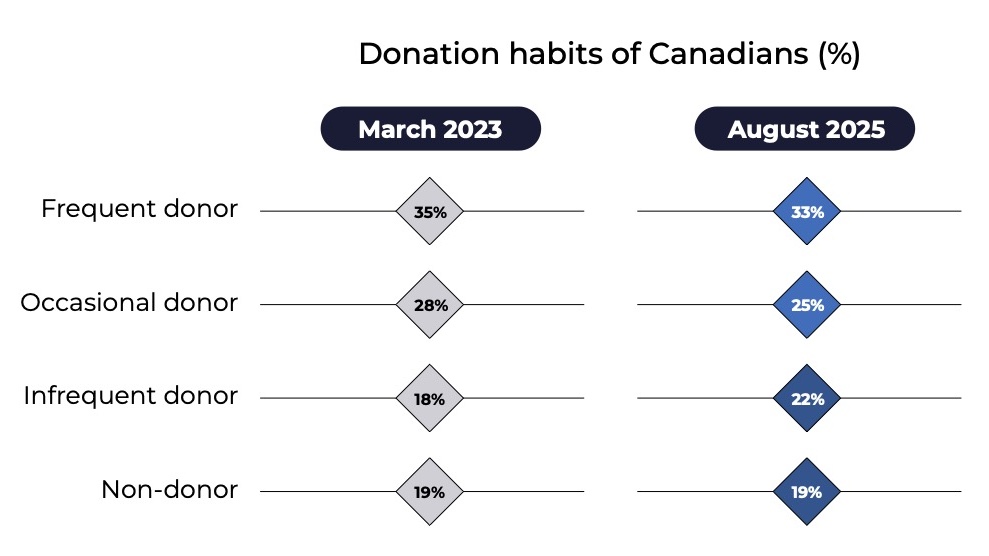
In a previous study conducted in March 2023, DS asked respondents to describe their donation habits towards charities and nonprofit organizations. When comparing those results to the current year, we can see that the proportion of frequent and occasional donors has decreased since March 2023, but not by a significant margin. 1/3 of Canadians in August 2025 still make financial donations to charities every year or almost every year, while 1/4 say they donate sometimes.
Donation amounts increase, but the donor base may be eroding
While the donation frequency of Canadians has not been hugely impacted by increases in the cost of living, we wondered whether there might still be a dip to the amount that they are able to donate.
On average, however, Canadians who donate are donating similar or even higher amounts than previously. When looking at the median annual self-reported donation amount in March 2023 and August 2025, our results show that it has remained exactly the same at $100 CDN. Additionally, when looking at the amounts donated based on donation frequency, the median donation amount for frequent donors has actually increased from $200 in March 2023 to $350 in August 2025, and it remained the same for occasional donors.
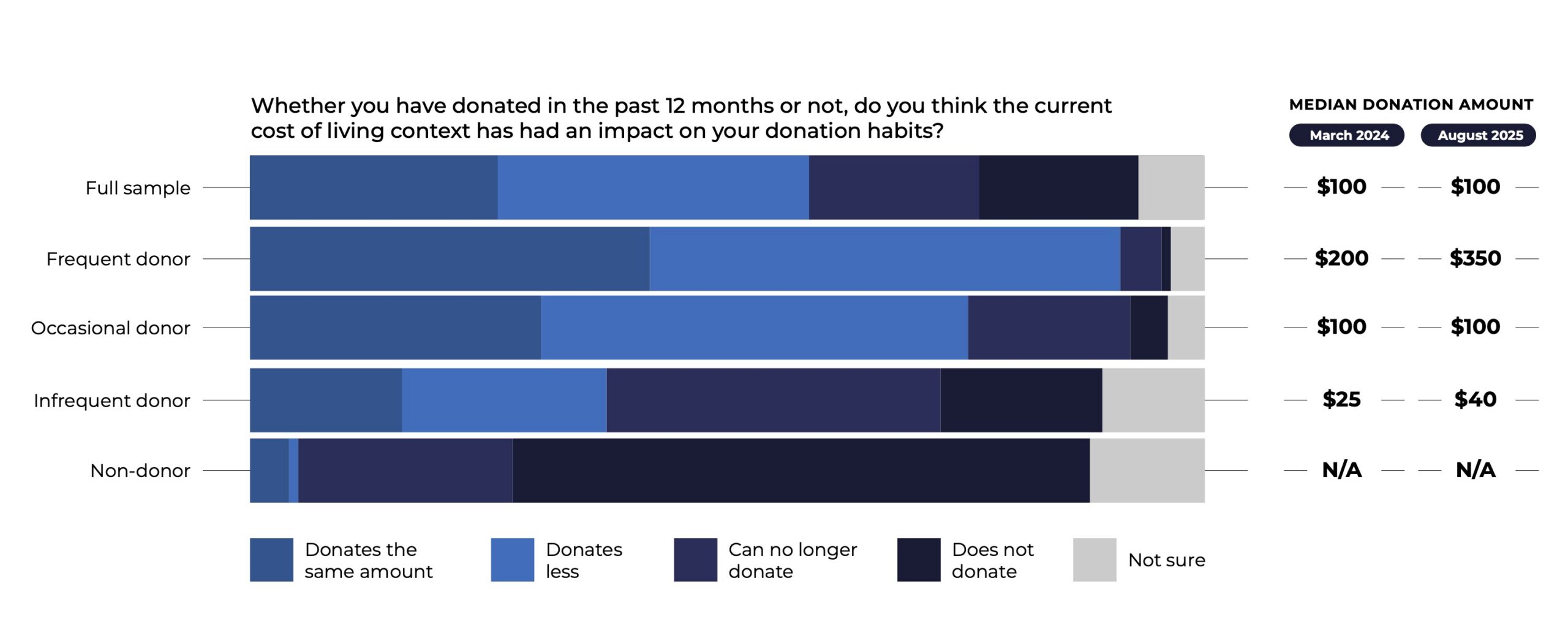
That is not to say that there has been no impact from the current cost of living. Half of frequent donors have said that they are now donating less as a result of increasing prices. 17% of occasional donors feel as though they are no longer able to donate due to rising costs, and the same goes for 35% of infrequent donors. Additionally, 22% of Canadians who do not donate to charity say the cost of living makes donating no longer an option for them. So while the median donation amount has not changed since 2023,the potential pool of donors appears to be shrinking as a result of the increasing cost of living.
Moreover, some sharper declines are observed among groups that tend to donate higher amounts. 58% of men over the age of 65 consider themselves frequent or occasional donors in August 2025, down from 74% in March 2023. 78% of Canadians with incomes over $100k donated frequently or occasionally in 2023, but that number fell to 67% in 2025. Other groups that tend to donate in smaller amounts, including women under 50 and high school graduates, continue to donate at the same frequency as before. Potentially losing the donations of these high-value groups could have drastic consequences for a charity or non-profit’s bottom line.
As such, unless there is a noticeable improvement in the cost of living for Canadians, it will be imperative for charities and nonprofit organizations to focus on targeting these high-frequency donors, as well as demographics likely to donate higher amounts, to make up for the potential decline in the number of Canadians donors.
(Note: This type of questioning can sometimes fall victim to “social-desirability bias”, where respondents over-report behaviour that is seen as good, and under-report bad behaviour.)
What does this mean for fundraising, particularly online fundraising?
1. Donor Stability Masks an Eroding Base
- The median annual donation remained steady at $100 between 2023 and 2025 for key accounts DS leads.
- Frequent donors increased their median gift from $200 in 2023 to $350 in 2025 for that same cohort.
- Yet, 18% of Canadians report they can no longer donate, and half of frequent donors say they are giving less than before.
- High-value donor segments are declining: men over 65 dropped from 74% frequent/occasional donors in 2023 to 58% in 2025, and households with incomes above $100K declined from 78% to 67%
Implication: Revenue stability is deceptive. Without intervention, the erosion of high-value donor groups could undermine future budgets.
2. Digital Fundraising as a Buffer to Economic Pressure
- Between FY2020 and FY2025, DS was able to scale digital fundraising programs by 10x in spend for key accounts and tripled donations, surpassing $1M in digital revenue.
- Channel strategies evolved from reliance on Google and Facebook to include Meta Reels, YouTube, LinkedIn, Bing, and Performance Max, creating full-funnel coverage.
- The move from campaign-based efforts to always-on engagement enabled nonprofits to sustain donor visibility year-round.
Implication: Digital diversification and always-on strategies provide resilience in a contracting donor market, ensuring consistent inflows of revenue and engagement.
3. Owning Audiences as a Retention Engine
As donor acquisition becomes more competitive and costly, owning direct relationships is emerging as a critical differentiator.
- Cost efficiency: DS has been able to bring in new leads at $15–$25 per contact, well below traditional media costs.
- Direct communication: Owned email lists enable targeted updates, impact storytelling, and timely donation asks.
- Retention through journeys: Automated email onboarding transitions contacts from sign-up → one-time gift → monthly giving, creating predictable pipelines.
- Audience building for scale: Owned lists improve remarketing, lookalike targeting, and segmentation, lowering acquisition costs and sustaining engagement.
Implication: Nonprofits that prioritize building and stewarding their own audiences will reduce reliance on external platforms, lower long-term costs, and strengthen donor loyalty.
4. Year-End Giving as a Pressure Point
- Holiday campaigns remain critical, with investment growing from $35K in 2020 to nearly $290K in 2024, more than doubling donation volume over the same period.
- Competition for donor dollars is intensifying as overall participation declines.
- Innovation matters: AI-enhanced targeting, urgency phasing, and varied creative formats (video, Reels, carousels) have delivered higher engagement and conversions.
Implication: Year-end campaigns remain the sector’s revenue accelerators, but success will depend on innovation, urgency, and reactivation of owned audiences.
Strategic Imperatives
To remain resilient in the face of economic strain and shifting digital dynamics, nonprofits should:
- Protect high-value donor segments through proactive stewardship and precision targeting.
- Invest in always-on, multi-channel engagement to counteract shrinking donor pools and sustain year-round visibility.
- Prioritize audience ownership by expanding lead generation and email stewardship to build reliable, cost-effective pipelines.
- Reimagine year-end campaigns with urgency, creative innovation, and reactivation strategies that maximize returns from a limited donor base.
Conclusion
The Canadian donor landscape is at an inflection point. While average donations remain resilient, the contraction of the donor base poses long-term risks.
Digital fundraising demonstrates a clear path forward: diversify channels, adopt always-on engagement, and build owned audiences that lower costs and strengthen retention.
Nonprofits that integrate these approaches will not only weather current economic pressures but also position themselves for sustainable growth in an increasingly competitive fundraising environment.
About the authors
Deeva is a seasoned digital strategist and client-services leader, serving as the VP, Growth at Data Sciences. She specializes in managing client relationships and driving innovative strategies for corporate and non-profit clients. Her experience includes leading multi-funnel donation campaigns for McGill University and overseeing resource and project management for PricewaterhouseCoopers’ financial services team in Toronto.
Marina is the Head of Media and Creative Teams at Data Sciences, specializing in performance marketing and omni-channel strategy. With over a decade of experience in digital marketing, she works with corporate, political, and non-profit clients to transform complex campaign objectives into highly efficient and actionable media plans. Her deep understanding of budget constraints and audience insights has been instrumental in helping numerous non-profit foundations and other clients meet and exceed their goals.